Office:
Address:
204, Monarch Chambers, Marol Maroshi Road, Marol Naka, Andheri (E), Mumbai - 400059, India
Email: nadkarnispc@gmail.com
Tel: +91 9820373895 / 9619608942
Reach us

Office:
Address:
204, Monarch Chambers, Marol Maroshi Road, Marol Naka, Andheri (E), Mumbai - 400059, India
Email: nadkarnispc@gmail.com
Tel: +91 9820373895 / 9619608942

WhatsApp:
+91 9619643952 / 9820373895
Technical Support:
Email: sales@nadkarnispc.com
Tel: +91 7972884515 / 9820373895

Customer Support:
Email: bonding@nadkarnispc.com
Tel: +91 9820373895
BLOGS WRITTEN BY PHD STUDENTS

Insights · Coating chemistry
Think of ethers as the unbreakable glue and esters as the reversible one. An ether bond (R–O–R′) is very stable, so it shrugs off water, acids and alkalis. An ester bond (R–COO–R′) carries a reactive carbonyl, so it hydrolyses: it breaks down when moisture, acid or alkali reaches it. In a coating, that one difference is what decides how long the film survives.
Imagine two different types of glue. One makes a robust bond that is stable in most environments. The other bonds well but can be broken down and reworked when you want it to. That contrast is the essence of ethers and esters, and for anyone formulating a coating it is not academic. It decides whether a tank lining holds for years or starts to delaminate in a season.
Before getting into where they are used, it helps to see what sets the two bonds apart. It comes down to a single reactive group.
R–O–R′
An ether bond is an oxygen linking two carbon groups. Nothing reactive hangs off it, so water has nothing to grab and the bond holds.
Ethers are the unbreakable glue.
R–COO–R′
An ester bond looks similar, but it carries a carbonyl, a carbon double-bonded to oxygen, right beside the linking oxygen. That carbonyl is the weak point. Water, acids and alkalis attack it and split the bond apart, by reactions such as hydrolysis and saponification.
The reversible one.
Small on paper, decisive in practice. Here is the contrast at a glance:
| Property | Ether bond (R–O–R′) | Ester bond (R–COO–R′) |
|---|---|---|
| Susceptible site | None | Carbonyl (C=O) group |
| Water / hydrolysis | Highly resistant | Hydrolysis over time |
| Acid & alkali | Stronger resistance | Weaker resistance; alkali causes saponification |
| Heat & oxidation | More stable | Less stable |
| Biodegradability | Low | Higher |
| Typical polymers | Epoxy resins, polyether polyols, PEG | Polyester, alkyd, PLA, PBS |
| Best suited for | Long-life, chemical-exposed coatings, primers | Cost-effective, compostable uses |
Two reactions explain most ester failures.
Hydrolysis is water slowly pulling the bond apart. Give it enough time and humidity and an ester drifts back toward the acid and alcohol it was built from.
Saponification is the faster, alkali-driven version. The name is no coincidence: it is the same reaction used to make soap, where caustic soda breaks the ester bonds in fats and oils. The catch is that this chemistry also attacks ester-based paint. An alkaline surface like fresh concrete, or a harsh cleaning wash, or corrosion salts will saponify an alkyd film and lift it off the substrate. (We looked at failures like this in the true cost of coatings.)
Ethers simply give these reactions nothing to work with.
Both bonds are already all around us.
Form the backbone of epoxy resins (most are based on bisphenol A diglycidyl ether), polyether polyols and PEG.
Run through polyester resins, alkyds, and biodegradable plastics like PLA and PBS, where the ability to break down is the whole point.
In air-drying coatings, the real contest is epoxy ether systems against alkyd ester (or even epoxy ester) systems. So we decided to test it.
Rather than argue the chemistry, we ran a side-by-side comparison in our own lab. Here is what we did.
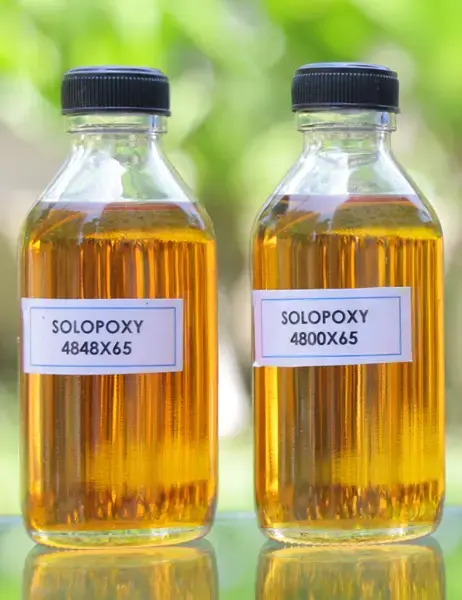
The alkyd film broke down within about 7 hours. Both SOLOPOXY films were still intact when observation ended, so no failure point was recorded for them. In-house test, not a published standard.
The result? The alkyd’s ester linkages saponified, just as the chemistry says they should, while the epoxy ether films carried on untouched. It is an in-house test rather than a published standard, but the difference was hard to miss, and it backs up what we have always maintained about epoxy ether durability.
Ether stability is not a free pass, and it is worth being clear about its limits. Aromatic ether and ester linkages both break down under prolonged UV. For a surface in constant sun, an aliphatic urethane or acrylic topcoat usually holds colour and gloss better than either. The ether advantage is strongest where protection from water and chemicals is important, such as below the waterline, inside a tank, across a factory floor.

None of this makes esters the lesser choice. They are often cheaper, easy to apply, and their biodegradability is a real advantage wherever a material is meant to break down. For plenty of general-purpose and indoor work, an alkyd is still the sensible, economical option where environmental factors are not aggressive.
The trade-off is service life in harsh conditions. Where a surface faces moisture, corrosive environment or alkalinity, an ester film is set up for an early failure, and the cheaper coating quietly becomes the expensive one once recoating and downtime are counted.
This is where SOLOPOXY sits in an interesting spot. Its epoxy ether durability is built on cashew nut shell liquid, a renewable feedstock, so there is no need to trade sustainability for durability. For the thinking behind that approach, the ACS 12 Principles of Green Chemistry are a good place to start.
When the film has to survive water, corrosive environment, alkalinity or a long service life: marine primers, tank linings, pipelines and protective coatings.
When low cost is the priority, exposure is mild and indoors, or biodegradability is what you actually want.
Understanding this one difference between the bonds is what lets a formulator match the chemistry to the job, rather than finding out about the mismatch after the coating has already failed.
For corrosion resistance, yes. Ether bonds have no susceptible sites, so they resist water, acids and alkalis far better than ester bonds, which hydrolyse over time. Raw mechanical strength depends on the whole polymer, but for durability in wet or corrosive environments, ethers win.
An ether is an oxygen linking two carbon groups (R–O–R′) with no susceptible sites. An ester has a carbonyl next to that oxygen (R–COO–R′), which makes it reactive toward water, acids and alkalis. That extra carbonyl is why esters hydrolyse and ethers mostly don’t.
The carbonyl carbon in an ester is slightly positive, which makes it an easy target for water, acids and alkalis. When they attack, the bond splits back toward an acid and an alcohol. Heat, moisture and alkalinity all speed it up. Ether bonds lack that reactive carbon, so they resist hydrolysis.
Generally yes. A small damage on a coated surface can expose the bare metal substrate and start corrosion. Corrosion on a metal surface forms alkaline salts. Epoxy ether coatings rely on ether linkages that resist saponification, the alkali-driven breakdown that attacks alkyds. In a 40% caustic soda test, an alkyd film failed within about 7 hours while SOLOPOXY epoxy films stayed intact. Epoxy ethers are usually the safer choice to protect corrosion prone metal surfaces as they can prevent further spread of corrosion.
Many are more biodegradable than ethers, because the ester bond is built to break down through hydrolysis. That is an advantage for compostable plastics like PLA, and a liability for a coating that has to survive environmental factors. Biodegradability and long-term durability pull in opposite directions.
SOLOPOXY resins contain epoxy ether linkages rather than the ester linkages found in alkyds or epoxy esters, so there is no carbonyl for alkali to attack. The resin is also derived from cashew nut shell liquid, a bio-based feedstock, which keeps it sustainable without giving up on durability.




Author:
Shikhin Nadkarni

Shikhin is currently a PhD Student in Coatings and Polymeric Materials Department at North Dakota State University. He is a member of Dr. Dean Webster’s Research Group and his research focuses on Non-Isocyanate Polyurethanes as well as novel Epoxy systems. He is passionate about incorporating bio-based materials in polymers so as to reduce our dependance on petrochemicals.
Other Blogs

Shikhin Nadkarni
Phenalkamides- The All-Weather Curing Agents
Hybrid Electric Vehicles (HEVs) are a hallmark of modern automotive innovation, blending the strengths of traditional internal combustion engines..
Iryna Bon
Mastering the Molecular Bake: A Guide to Modern Analytical Methods for Polymer Characterization
Polymers are an impure mixture of molecules of different sizes and shapes. Scientists have developed advanced equipment and methods to understand the

Shikhin Nadkarni
SIMPLIFIED: Paint Technology 101
Paint is everywhere. From the walls of our homes to the sleek finish on a car, coatings have become an essential aspect of modern life..
Shikhin Nadkarni
Understanding Cathodic Disbondment: A Comprehensive Exploration
Corrosion of metal is a common issue that causes massive financial losses. Cathodic protection (CP) is a popular method employed to prevent corrosion.
Shikhin Nadkarni
Chemistry in a Nutshell: Cashew Nut-Shells to Phenalkamines
The banana fruit is a renewable agricultural product packed with high nutritional value. Once we peel the banana to reveal and consume the superfood..
Bohdan Domnich
Enhancing Coating Adhesion: A Comprehensive Guide to Epoxy Resins and Their Applications Across Various Substrates
Adhesion is the ability of a material to form a joint between two substrates. It is one of the most crucial properties of coatings yet one of the most